


Tattoo & birthmark removal
Q-switched laser treatment to fade unwanted tattoos and certain pigmented birthmarks over a course of sessions, after assessment.
Sessions
Often 6–10 or more sessions, 6–8 weeks apart
Downtime
Redness, swelling and pinpoint bleeding or crusting for 5–7 days
Results
Gradual fading after each session; complete clearance is not always possible
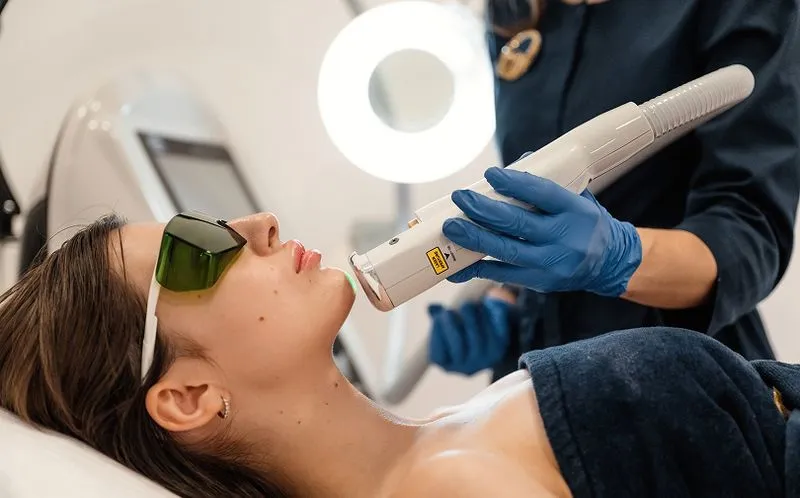
What to expect during your visit
Short, high-energy laser pulses break tattoo ink or excess pigment into smaller particles, which the body clears gradually over the following weeks.
Black and dark blue inks usually respond best; some colours fade slowly or incompletely. Professional tattoos often need more sessions than amateur ones. Birthmarks vary widely in response.
Every plan begins with a consultation with Dr. Darshana, Consultant Dermatologist, who confirms whether this treatment suits you.
Clinical indications & suitability
Concerns addressed by this protocol
- People who want to remove or fade a tattoo, including to prepare for a cover-up.
- People with pigmented birthmarks such as naevus of Ota or café-au-lait marks, after assessment.
- Not all birthmarks are suitable; some need a different treatment or a specialist referral.

Before & after your session
Before your session
- Avoid sun exposure on the area for 2 weeks before.
- Tell us about any history of keloids or poor healing.
Aftercare
- Keep the area clean, apply the prescribed ointment and do not pick blisters or crusts.
- Protect the area from sun for several weeks.
Risks & side effects
- Redness, swelling, blistering and crusting.
- Temporary lightening or darkening of the surrounding skin.
- Incomplete removal or ghosting of the design.
- Rarely, scarring or texture change.
Procedure: Minimally invasive.
Individual results vary. Your dermatologist will discuss the risks that apply to you before treatment.
Tattoo & birthmark removal: FAQs
Most tattoos can be faded significantly, but some colours and very dense tattoos may not clear completely.
Book your protocol consultation
Explore other clinical protocols

Laser toning for pigmentation & melasma
Low-energy Q-switched Nd:YAG laser toning for melasma, freckles, tanning and uneven tone, as part of a medical pigmentation plan.

CO2 laser for acne scars
Fractional CO2 laser resurfacing to improve acne and chickenpox scars, often combined with subcision or PRP, after a scar assessment.

Mole, cyst & lipoma removal
Minor in-clinic removal of moles, cysts, lipomas, fibromas, skin tags and warts under local anaesthetic, with care to minimise scarring.
Also in Laser Skin Treatments
- Rosacea, melasma & freckles
- Tanning & open pores
- Lip, face & neck pigmentation
- Body pigmentation (underarm, inner thigh, chest, back, arms, legs, abdomen)
- Anti-ageing, photofacials & laser toning
- Acne & chickenpox scar reduction
- Skin lightening & rejuvenation
- Skin sagging & tightening
- Stretch marks & scar repair (CO2 / microneedling + PRP/GFC/meso)
- Mole, wart, skin tag & corn removal