Laser hair reduction on Indian skin: sessions, safety and what to expect
A dermatologist’s guide to laser hair reduction in Bengaluru: how diode and Nd:YAG wavelengths work on Indian skin, session intervals and preparation.
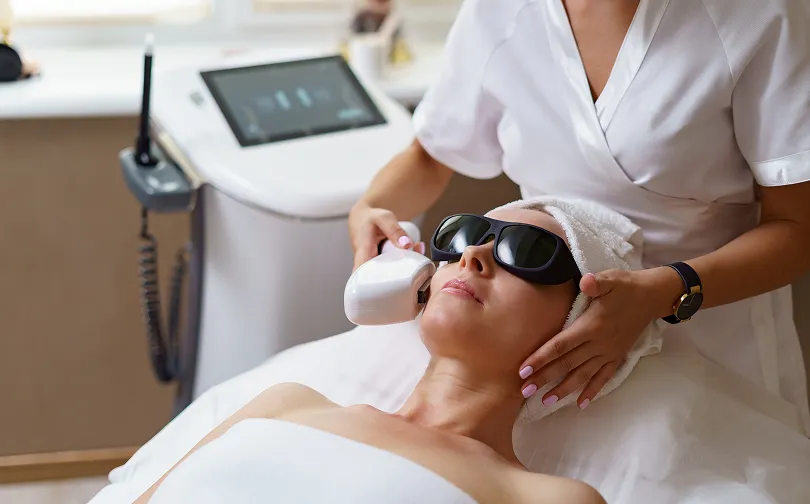
How medical lasers target hair follicles safely
Laser hair reduction works through selective photothermolysis: a specific wavelength of light is absorbed by melanin inside the hair shaft and converted into controlled heat, which disables the follicle’s growth centre while contact cooling protects the surrounding skin.
Beyond reducing the need for shaving or waxing, dermatologist-supervised laser hair reduction is frequently recommended for recurrent ingrown hairs (pseudofolliculitis), waxing folliculitis and post-inflammatory dark marks on the underarms, legs or jawline.
1. Choosing safe wavelengths and cooling for Indian skin tones
Because Indian skin (Fitzpatrick IV to V) contains more epidermal melanin, device selection and parameter calibration are critical:
- Longer wavelengths (Diode and Nd:YAG): penetrate deeper toward the hair bulb with less competing absorption in the surface epidermis.
- Integrated sapphire contact cooling: keeps the skin surface cool throughout each pulse, improving comfort and reducing the risk of thermal burns or pigmentation.
- Patch testing and fluence titration: energy settings are matched to hair thickness, skin tone and body area at each visit.
2. Why multiple sessions are needed across the growth cycle
Lasers only disable follicles that are in their active growth stage (anagen), when the hair root is rich in melanin and anchored to the bulb. Because only a fraction of hairs are in anagen at any one time, 6 to 8 sessions spaced 4 to 8 weeks apart are typically needed for 70–90% long-term reduction in coarse dark hair.
"Sudden coarse hair growth on the chin, jawline or chest in women can be a sign of underlying androgen excess such as PCOS. Pairing hormonal evaluation with laser sessions gives far steadier long-term control."— Dr. Darshana (Consultant Dermatologist)
3. Preparing for your session and aftercare
Simple preparation makes each session safer and more effective:
- Avoid waxing, plucking, threading or epilating for 3 to 4 weeks before treatment so the hair root remains intact for the laser to target; shaving is permitted.
- Avoid active tanning and pause strong retinoids or glycolic creams on the area for 3 to 5 days prior.
- After treatment, use a cool compress or soothing gel if mild perifollicular redness appears, avoid hot showers and gym heat for 24 hours, and apply SPF 50+ on exposed areas.
Book a digital skin barrier assessment
Consult Dr. Darshana for a dermoscopic analysis and bespoke medical skincare blueprint.

More from the Skin Journal

A dermatologist’s guide to repairing a damaged skin barrier on Indian skin

Collagen banking in your 30s: when to introduce retinoids, peptides and Profhilo